
Get a Free Quote For Your Home
Find out how much a solar system would cost for your home
Solar Panels Types: Choosing the Best Option for Your Home

Thinking about solar panels for your place? It can get a little overwhelming, honestly. There are just so many types and features out there.
Tech keeps changing, too—panels are getting more efficient and prices keep shifting. So, how do you even start figuring out the best fit for your needs?
Let’s break down the main types of solar panels, with a quick look at their costs, strengths, and how well they work. Whether you’re all about saving money, chasing the latest tech, or just want something that works for your roof, there’s something here for you.
Key Takeaways
- Main differences between nine types of solar panels
- Which panel type might fit your home and budget
- Fresh advice on emerging solar tech
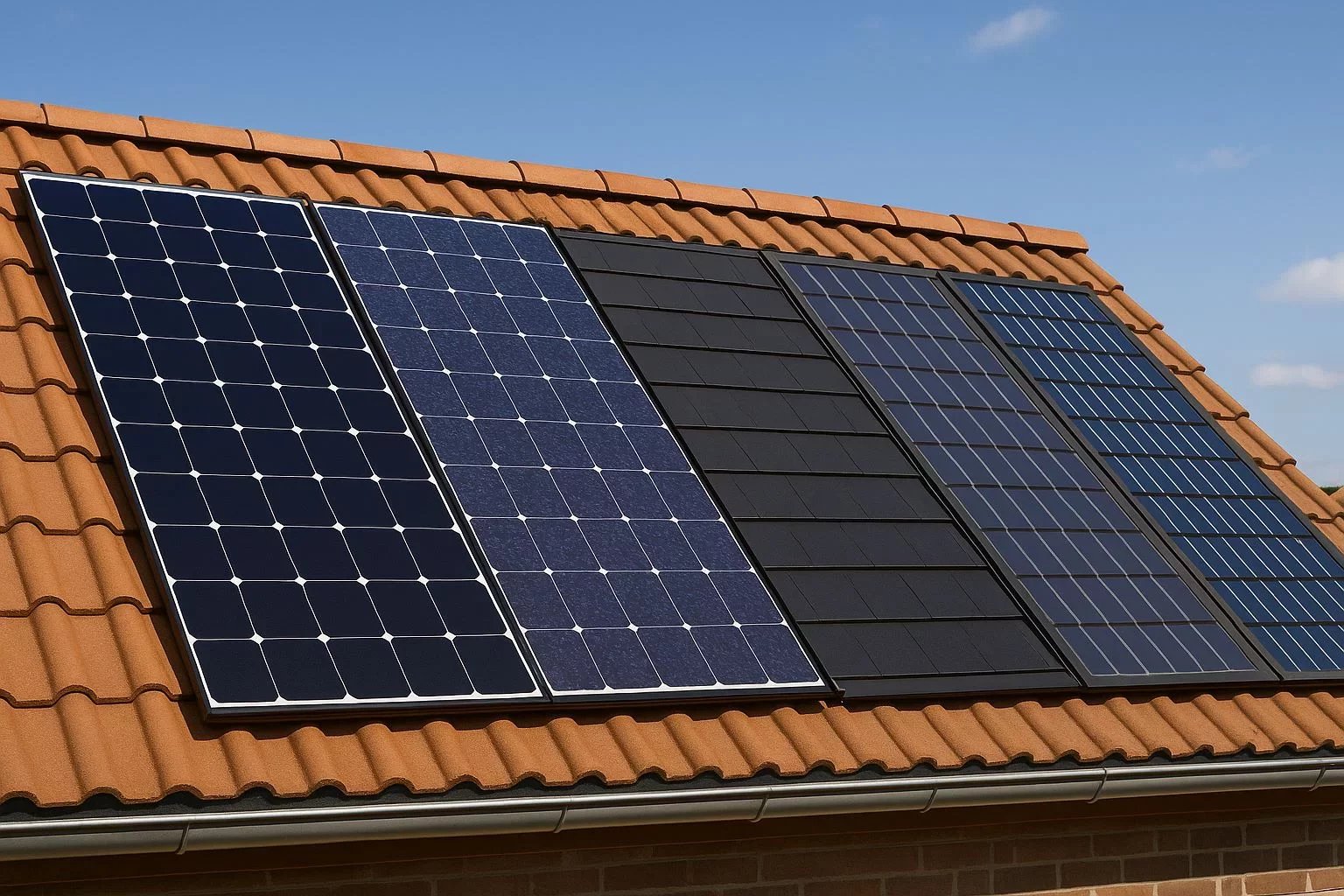
Which Nine Types of Solar Panels Are There?
There are nine main types of solar panels you’ll come across. Each uses a different technology and brings its own quirks.
You’ll find quick guides for each type below. They cover how they work, efficiency, cost, and whether they might suit your place.
Single-Crystal Silicon Solar Panels
Single-crystal silicon, or monocrystalline, panels are kind of the gold standard for homes. They’re made from one big, pure silicon crystal, sliced up into thin wafers.
Because the atoms line up so neatly, these panels turn sunlight into electricity more efficiently than most others. You’ll spot them by their smooth, black finish.
They’re tough—up to 40 years of life isn’t unusual. Bad weather doesn’t faze them much. If you want the most energy squeezed out of your roof, this is usually the way to go, though you’ll pay more per square metre.
Quick Facts:
- Efficiency: 18–24%
- Lifespan: 25–40 years
- Cost: Higher than average
- Available: Yes
Why choose single-crystal panels?
- Great for small roofs
- Lower electric bills
- Sleek, modern vibe
Things to keep in mind:
- They’re pricey
- Production isn’t the greenest
If you want panels that last, look sharp, and save you money over time, monocrystalline is a solid bet. More on monocrystalline solar panels.
Multi-Crystal Silicon Solar Panels
Multi-crystal, or polycrystalline, panels are made by melting together chunks of silicon and slicing them into wafers. This wastes less material, so it’s a bit more eco-friendly.
They have a blue, speckled look. Cheaper to buy, but you’ll need more space for the same power output since they’re not quite as efficient.
Quick Facts:
- Efficiency: 13–16%
- Lifespan: 25–30 years
- Cost: Less expensive
- Available: Yes
Why choose multi-crystal panels?
- Lower upfront cost
- Slightly greener to make
Drawbacks:
- Not as efficient
- Not the prettiest
- Cost per watt can creep up
If budget’s your main concern and you’ve got plenty of roof, polycrystalline could work. Check out our polycrystalline solar panels guide.
Flexible Thin-Film Solar Panels
Flexible thin-film panels use layers of photovoltaic material—like amorphous silicon, cadmium telluride, or copper indium gallium selenide—applied right onto glass, plastic, or metal. That makes them bendy and lighter than the usual panels.
You’ll see these on curved roofs, vehicles, or mobile homes. They’re easy to install where regular panels just won’t go. The trade-off? Lower efficiency, so you might need more panels or accept less power.
Quick Facts:
- Efficiency: 7–13%
- Lifespan: 10–20 years
- Cost: Cheapest option
- Available: Yes
What’s good:
- Super lightweight
- Fits odd shapes and mobile setups
- Costs less
What’s less good:
- Less power
- Won’t last as long
Thin-film panels come in a few flavours:
- Amorphous silicon: flexible and cheap, but least efficient
- Cadmium telluride: better output, but uses some nasty stuff
- Copper indium gallium selenide: decent performance, flexible, pricier
For quirky installs—sheds, caravans, weird roofs—thin-film is worth a look. More at thin film solar panels.
See-Through Solar Panels
See-through (or transparent) solar panels are made for windows and glass. They let a bunch of sunlight pass through while turning some into power. Perfect for commercial buildings, greenhouses, or maybe someday your phone.
They use special tech that only targets invisible light like UV and IR, so your windows won’t get all gloomy. Lab models can get up to 86% transparency, but what’s out there now is less impressive.
Quick Facts:
- Efficiency: 1–10%
- Lifespan: 25–30 years
- Cost: More expensive
- Available: Yes, but rare and pricey
Advantages:
- Doesn’t mess with your view
- Works in offices, skylights, or gadgets
- Lets you have light and power
Disadvantages:
- Pretty low efficiency
- Costs a lot
- Not much in it for most homes
Transparent panels are a bit niche, but if you’re running a business or dreaming about future tech, they’re worth watching. Curious? Here’s more on transparent solar panels.
Focused Sunlight Photovoltaic Panels (CPV)
Focused sunlight photovoltaic panels—usually called Concentrator Photovoltaics (CPV)—use mirrors or lenses to concentrate sunlight on tiny, super-efficient cells. They work best in really sunny places and usually need tracking systems to follow the sun.
Efficiency can blow past 40%, but the tech is expensive and not really meant for homes. You’ll see these in big solar farms, not on your neighbour’s roof.
Quick Facts:
- Efficiency: 35–50%
- Lifespan: 25–35 years
- Cost: Not for home use
- Available: Nope (for households)
Benefits:
- Wildly high efficiency
- Uses advanced, compact cells
Downsides:
- Needs tracking and cooling
- Too big and complex for regular roofs
- Out of most people’s price range
If you’ve seen those massive solar arrays in the desert, that’s probably CPV. Want to nerd out? Read about Concentrator Photovoltaics (CPV).
Advanced PERC Solar Panels
Advanced PERC (Passivated Emitter and Rear Cell) panels are a tweak on standard silicon cells. They add a layer at the back to bounce unabsorbed light back through the cell, grabbing a bit more energy.
PERC cells also stay cooler, so you lose less power on hot days. A lot of newer panels now use PERC tech, often mixed with other upgrades.
Quick Facts:
- Efficiency: 17–20%
- Lifespan: 25–35 years
- Cost: Mid to high
- Available: Yes
Why consider PERC:
- More juice from the same space
- Works better in hot climates
- Still affordable for what you get
Limitations:
- Newer stuff is coming fast
- Not quite the top dog anymore
If you want an upgrade without breaking the bank, PERC panels are a safe bet. For more, see Passivated Emitter and Rear Contact panels.
Perovskite Layered Panels
Perovskite solar panels use a synthetic material that mimics some natural minerals’ structure. It’s layered onto silicon (tandem cells) or sometimes used alone.
These panels have made waves for their rapid progress—some lab versions already beat commercial options in efficiency. The catch? They’re not quite ready for the real world yet; durability and mass production are still hurdles.
Quick Facts:
- Efficiency: 28.6–33.7% (test cells)
- Lifespan: 25–30 years (lab)
- Cost: Not in stores yet
- Available: No
Highlights:
- Tech of the future
- Could be cheaper and more efficient
- Flexible, thin
Barriers:
- Still in early days
- Real-world lifespan is a question mark
Perovskite is exciting, honestly. Once it’s ready, it could change the game for solar.
Solar Roof Tiles
Solar roof tiles (or building-integrated photovoltaics) blend solar tech right into your roofing. They look like regular tiles but generate power.
If you’re building a new place or re-roofing and want a clean, low-profile look, tiles are appealing. They’re a bit less efficient than regular panels, so you’ll need more roof space for the same output.
Quick Facts:
- Efficiency: 10–20%
- Lifespan: 25–30 years
- Cost: Mid to high
- Available: Yes
Benefits:
- Discreet, blends in
- No big, obvious panels
- Works for protected or listed buildings
Drawbacks:
- More expensive per watt
- Installation’s a specialist job
If looks matter as much as savings, solar tiles are worth considering. More info on our solar roof tiles page.
Sun-Driven Thermal Panels
Sun-driven thermal panels—sometimes called solar thermal or solar hot water panels—don’t work quite like the others. Instead of making electricity, they use sunlight to heat water or some other liquid for your home.
You’ll usually find them paired with a regular heating system, so you get hot water year-round. These panels really shine in big houses or anywhere with hefty hot water needs.
Solar thermal is impressively efficient for heating, but don’t expect it to run your electronics. That’s just not what they’re built for.
Quick Facts:
- Efficiency: Up to 70% for heat production
- Lifespan: 20–25 years
- Cost: Higher initial setup
- Available: Yes
Pros:
- Cuts your water heating bills
- High heat conversion rates
- Pairs well with other renewable sources
Cons:
- Won’t generate electricity
- Can cost more upfront than PV panels
At a Glance: Solar Panel Comparison
*Solar thermal efficiency refers to turning sunlight into heat, not electricity.
Deciding Which Solar Panel Suits Your Needs
Choosing the right solar panel? It really comes down to what matters most for you and your home.
If you want a modern, tidy look, monocrystalline panels are hard to beat. They’re efficient, durable, and don’t stick out like a sore thumb.
If you’d rather your panels disappear into the roof, transparent panels or solar roof tiles might be more your style. They’re subtle, almost invisible once installed.
Got a tight budget? Thin film panels cost less upfront, though you’ll usually get less energy and they won’t last as long. Still, some folks find monocrystalline panels pay off faster, just because they’re more efficient and can shrink those electricity bills quicker.
Here’s a quick comparison:
And don’t forget, new tech like perovskite panels could shake things up even more if they hit the market soon.
Tip: Ask yourself—do you care most about energy savings, upfront price, or how panels look on your home? Jot down your priorities and compare carefully. More details? Check out this guide to the different types of solar panels.
Evolving Solar Technologies
Tiny Semiconductor Advances
Quantum dot panels are a bit wild—these use super tiny semiconductor specks, just a few billionths of a metre across. They can be layered thinly and flexibly, which opens up all sorts of design options.
The real party trick is multiple exciton generation. Basically, quantum dots squeeze more electricity out of each bit of sunlight than regular panels can.
Homes today usually get 15–25% efficiency from standard panels, but quantum dots might reach a whopping 66%.
Advantages of quantum dot panels:
- Use much less raw material
- Can be flexible, lightweight, even see-through
- Expected to lower solar electricity costs
- Flexible manufacturing possibilities
Here’s how they stack up:
Light-Adapting “Undead” Panels
“Zombie” panels? Odd name, but it fits. These use a special thin film with a colourful dye that grabs light and sets electrons moving.
What’s weird is that their liquid electrolyte actually works better as it dries out—hence the “undead” nickname. They keep running, even when you’d expect them to stop.
Unlike most panels, these can handle both indoor and outdoor light. They’re tiny—think credit card or phone-sized—but still manage 30–34% conversion efficiency.
That could mean future gadgets powered indoors, even with weak light. Pretty cool, honestly.
Key Features:
- Works in low or artificial light
- Small, portable, and adaptable
- Novel use of drying electrolyte for higher efficiency
What To Do Next
Thinking about solar panels? Start by jotting down your main priorities—cost, efficiency, looks, whatever matters most.
Then, fill out a quick form about your home. This helps match you with local installers who know their stuff.
Soon you’ll get quotes to compare. Simple enough.
Top Tips:
- Make a list of your home’s energy needs
- Review quotes from installers
- Ask questions about warranties and installation times
It doesn’t have to be complicated. Take it one step at a time and you’ll get there.
FAQs
Which Solar Panels Suit UK Homes Best?
For most UK homes, monocrystalline panels are the go-to. They’re made from high-purity silicon, which means they’re pretty efficient at turning sunlight into electricity—even on those classic grey days.
You’ll usually get more out of them than polycrystalline or thin film panels, and they tend to last longer too. Sure, they cost a bit more upfront, but they often pay for themselves faster.
There’s always something new on the horizon—perovskite-silicon tandem panels, for example, promise even better efficiency. They’re not widely available yet, though, so for now, monocrystalline is still the best bet for most homes.
If you want to dig deeper, check out the GreenMatch overview on solar panel types.
What Solar Panel Type is Most Popular?
Most UK rooftops? You’ll see monocrystalline and polycrystalline panels. Both use silicon, but they’re made a bit differently, which affects how they look and work.
Monocrystalline is edging ahead these days. People like their higher efficiency, longer lifespan, and that sleek black look that just seems to fit modern homes. Polycrystalline panels are still around—they used to be everywhere—but they’re slowly losing ground.
Here’s a quick side-by-side:
Tech keeps moving, so who knows what’s next? For now, monocrystalline is the crowd favourite, with polycrystalline holding on in second. Want more details? Try this complete guide on solar panel types for the UK.
Is Monocrystalline or Polycrystalline Better for Your Home?
Choosing between monocrystalline and polycrystalline solar panels actually matters if you want to squeeze the best value and savings out of your solar setup.
Most experts lean toward monocrystalline panels for UK homes. These panels are more efficient, so you get more electricity out of the same sunlight.
Monocrystalline panels usually last longer, too. They tend to look a bit sleeker, with that neat, black finish—honestly, it just looks better on most roofs compared to the blue, speckled polycrystalline panels.
Polycrystalline panels can be cheaper upfront. But once you factor in energy output and how long they’ll last, monocrystalline panels usually win out for value.
Reasons to pick monocrystalline:
- Higher efficiency, so you get more electricity from your roof
- Cheaper overall cost per watt
- Longer lifespan and warranties
- Better looks for many modern homes
If you want a system that actually helps you save money sooner, monocrystalline is usually the smarter investment. The upfront cost is a bit higher, sure, but you’ll probably break even faster, and those panels just keep on working for years.
Curious about the nitty-gritty or have more questions? Check out the solar panel FAQs.
Get a Free Solar Quote in 60 Seconds
Find out how much solar panels would cost for your home
Get a Free Quote For Your Home
Find out how much a solar system would cost for your home
